

Have you ever found yourself thinking that casinos are all about luck, or the lack of it?
You go in, place a few bets and hope for the best. If not, it’s not your night. And that’s it.
Many people think this, especially those who are just passing through and not going to analyse anything. However, if you talk to regular online casino players from Bangladesh, you’ll find that it’s a little more complicated than that. Not because of formulas or ‘secrets’, but because the games themselves feel so different.
We asked these players simple questions about their experience, expectations and behaviour while playing, rather than about calculations.
Interview: how players understand mechanics without numbers
– People say casino games are pure randomness. Do you agree?
In general – yes. You cannot predict a single spin or round in advance. But over time, you start noticing that different games behave differently. Not in terms of winnings, but in how they feel.
– What do you mean by that?
For example, in some slots, nothing happens for a long time and then there’s a sudden burst of activity. In others, something appears more frequently, but in smaller quantities. This doesn’t make the game better or worse – it just changes the rhythm.
Small observation: According to platform data, more than 60% of short sessions (up to 20 minutes) in Bangladesh end without any significant events occurring. This is why players often remember the ‘mood’ of the game rather than the result.
 Many people look at RTP. Do you?
I see it more as a reference point. I don’t expect a high RTP to produce results tonight. It just helps me to understand that, in the long run, the game is not too aggressive.
So RTP is not a guarantee?
Of course not. In a short session, it tells you almost nothing. You could play for ten minutes and not notice any difference between 94% and 97%.
Most players in Bangladesh spend between 10 and 25 minutes on one slot, which is statistically too short a time for the RTP to really ‘show itself’.
What about volatility?
That is felt faster. High volatility means that it can be quiet for a long time and then a spike appears. Low volatility means there is almost constant movement, but no surprises.
Psychology: where mistakes appear most often
What usually throws players off?
The most common thing is the feeling of ‘almost getting it’. When two symbols appear and the third one is missed, it feels like you are very close.
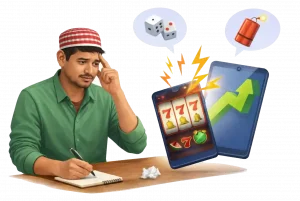 Even though, in reality, it means nothing.
Yes. But the brain reacts differently. It remembers these moments more strongly than ordinary losses.
And what about streaks?
That’s a classic example. After a long run of bad luck, you feel that luck is ‘due’. After a win, the urge to increase the bet is strong. This is not logical. It’s emotion.
What actually helps to avoid this state of mind?
Over time, it becomes clear that it’s not about calculations or trying to control anything. It’s more about noticing your own state of mind. When irritation arises, or the urge to speed things up, many players simply stop. Not as a rule, but as a reaction to the moment.
What about other players’ experiences?
Do you read discussions or chats?
Sometimes. You can learn about the interface, demo modes, how payments in BDT work and the meaning of statuses such as ‘pending’ or ‘processing’.
Most questions in local communities are not about winnings, but about convenience, such as game loading, freezing, payments and processing times.
But do you follow other people’s advice?
No, one good evening can easily become a ‘method’. I read things, but I only check them for myself. Everyone has a different rhythm, mood and set of expectations.
Ultimately, discussions about RTP and volatility help you to understand how a game generally behaves. However, how a specific game feels almost always depends on a player’s expectations, emotions, and knowing when to stop.